Funeral Homily for Br. Gerlac O’Loughlin 9/26/26
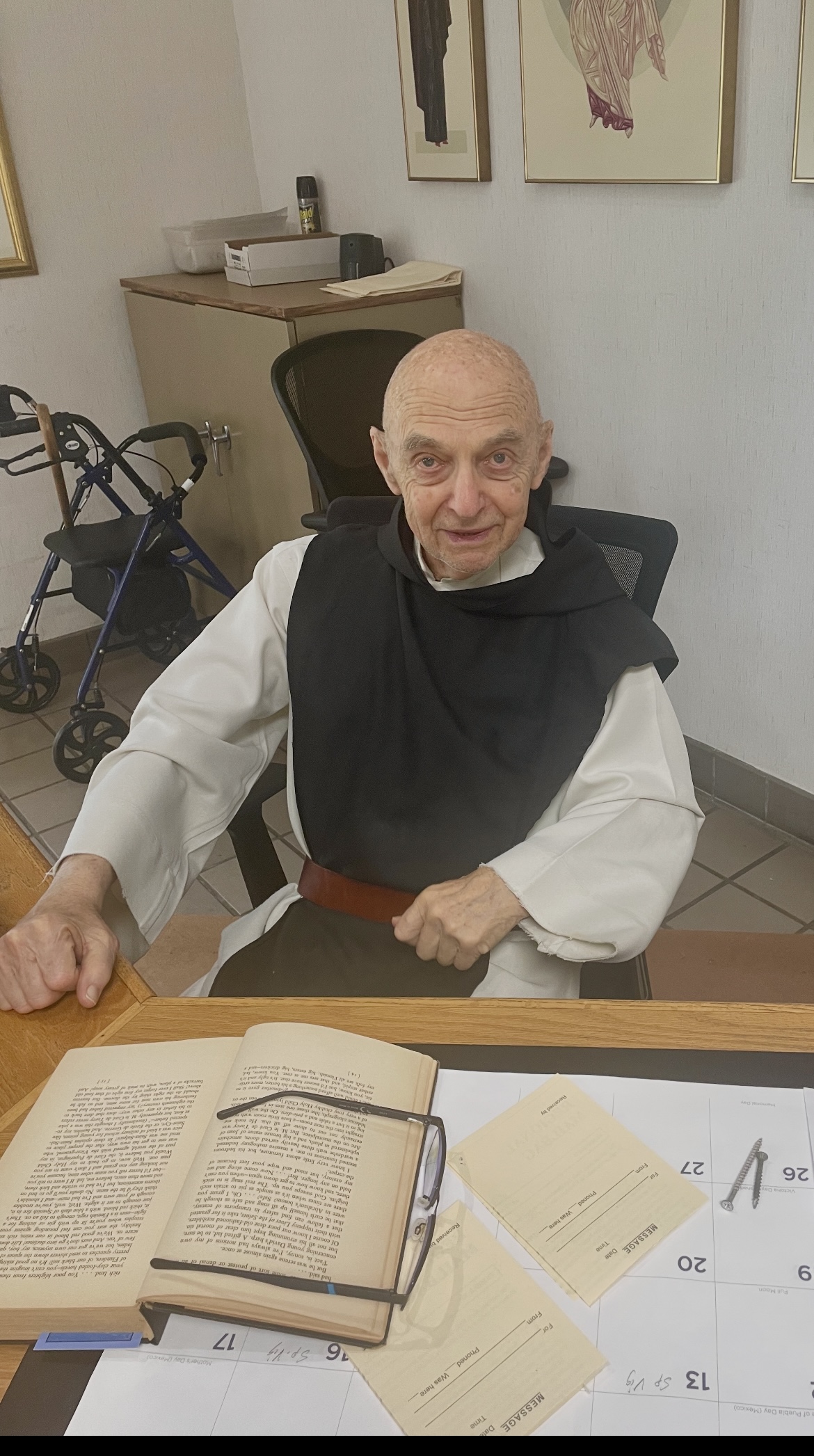
Funeral Homily for Br. Gerlac O’Loughlin (d. September 26, 2026)
Readings: Wis 3:1-9; Rom 14:7-9;10c-12; Jn 14:1-6
During his last years, Br. Gerlac had a pretty severe case of scoliosis. If I
walked behind him, I was never sure what part of him was going in which
direction. Sometimes, if I tried to get around him to the right, he drifted to
the right; and if I tried the left, he drifted to the left. I once asked him if he
was doing that on purpose, to which he replied, “Maybe you were going the
wrong way.” I’m sure we’ll all remember him for his quirky sense of humor.
He liked the comic strip The Far Side; and I liked to think of him as living on
the far side.
And yet, Br. Gerlac was quite a serious and complex guy. On one hand, he
was a little anti-authoritarian around the edges; he would usually side with
the underdog in a misunderstanding or conflict. If you were a priest or well-
educated, it was an uphill climb to gain his respect. On the other hand,
during much of his monastic life he held positions of authority and was
often the abbot’s right-hand man. I don’t think anyone else in living memory
here has had all the key jobs: cellarer, novice director, and prior. He was
unassuming, service-oriented, generally cheerful, and at the same time
bluntly honest both with himself and occasionally with others.
A big factor in his life was that he entered the community as a lay-brother.
He identified heart and soul with that vocation as it was in the now distant
1950s. He adapted to the changes over the years, but never really let go of
the lay-brother ideal. As you can see, we aren’t burying him in a choir
monk’s cowl. Br. Gerlac was not the nostalgic type, but he always remained
interested in earlier generations of monks and was curious about what
became of the many brothers who entered but did not persevere. He kept
lists and records, marked up old photographs, and in some cases stayed in
touch with former brothers. For the abbey’s 150 th anniversary he played a
big role in organizing a reunion of former monks. No doubt, that gesture
meant a lot to those men. And, no doubt, Br. Gerlac’s image of heaven is
one of many dwelling places for all imaginable varieties of characters.
It’s not the Br. Gerlac lived in the past—far from it. What seems to have
fascinated him was the experience of being called, which was the topic of a
master’s thesis he wrote in the 1970s. It was an appropriate topic for
someone who was novice master for many years, but there was more to it
than that. The job that most suited him and the one he seemed most to
identify with was that of vocation director. Vocations are a mystery, and
perseverance has more to do with God’s grace than with human effort. At
the same time, the recipient of a vocation remains a human being with a
personal history and a unique personality. As he did with former monks, Br.
Gerlac often stayed in touch with candidates even if they never entered.
I’m guessing that sorting out what a vocation is and what happens when a
person responds to it was for him an essential question. His own vocation
was strong and deep, and yet, in the prime of his life he was faced with
fundamental changes to the way that vocation was lived out here at
Gethsemani. Responding to a call involves abandoning other possible
plans. But what happens when the big plan of what you perceived as your
calling has to change? He found out the hard way that the intense initial
response must be followed my many smaller responses. A vocation can
never be reduced to a past event; it has to be a living reality. By
maintaining a deep interest in the people who had experienced the same or
a similar vocation, Br. Gerlac steered clear of the pitfall of resentment and
avoided getting stuck in the past. His sober, wise, and down-to-earth
demeanor can show us what it means to fully engage with a calling. A real
vocation is a chastened vocation. As we heard from the Book of Wisdom
about those who persevere: “Chastised a little, they shall be greatly
blessed, because God tried them and found them worthy of himself.”
I think it’s safe to say that, in working out his vocation, Br. Gerlac had the
humility to accept that God is at work on a larger scale than any one
person’s preferences. Even though the lay-brother calling he so identified
with disappeared, he discovered the living heart of that vocation, which is
that the best we can do is contribute generously on a small scale to the
vast scale of God’s plan for each and all.